Adside vs Runneth: one studies your ads, one runs them
Runneth, Motion's AI teammate, analyzes your Meta and TikTok creatives and briefs your team from a dedicated cloud machine. Adside launches, monitors and optimizes the campaigns themselves on Meta, Google and LinkedIn. Same budget line, different jobs. Here's how to pick.
Runneth and Adside cost almost exactly the same to start ($999 and $990 a month) and do almost entirely different jobs. Runneth, launched by Motion on June 24, 2026, is an AI creative strategist: it studies every ad you and your competitors have run, then briefs your team in Slack.³ Adside is an AI ads platform: it generates statics, launches campaigns on Meta, Google and LinkedIn, then monitors and optimizes them around the clock.
I run Adside, so read this knowing where my incentives sit. Everything on the Runneth side comes from Motion's own published pages and help docs, with sources at the bottom, and I'll tell you plainly where their product is the better choice. It often is.
The short version
- Runneth is an analyst and strategist, not a media buyer. It analyzes creatives, writes briefs and hooks, and reports. Motion's own line: "humans still own the decisions."¹
- Adside is an execution platform. Static generation, bulk launch, 24/7 monitoring, auto-rotation and reporting on Meta, Google and LinkedIn.
- Channel coverage decides a lot. Runneth's ad data covers Meta and TikTok. Adside runs Meta, Google and LinkedIn. B2B teams are outside Runneth's lane.
- Pricing logic differs more than price. Runneth is spend-tiered, usage-metered and sales-activated from $999/mo.² Adside is a flat $990 per brand with everything included.
- They stack. Runneth decides what to make. Adside gets it live and keeps it alive. Bigger teams can justify both; smaller teams should buy against their actual bottleneck.
What Runneth actually is
Motion has been the creative analytics company for paid social since 2021: visual-first reporting on Meta and TikTok ads, AI tagging of hooks and formats, frame-by-frame video analysis. The Toronto company has raised $42M in disclosed funding, including a $30M Series B led by Inovia in September 2024, and says 2,100+ teams analyze $14 billion in yearly media spend through it.⁵
Runneth is what they built on top of that data. Each customer gets a dedicated, always-on virtual machine in the cloud (Azure, Canada Central) and a persistent, org-wide memory Motion calls the Brain: a real filesystem holding your brand context, customer voice and preferences.⁶ You talk to it from Slack, the Motion app or a CLI. CEO Reza Khadjavi's launch essay frames it as "the Mac Mini in the cloud": the 24/7 agent setup that the most AI-obsessed marketers were hand-building, productized.⁷
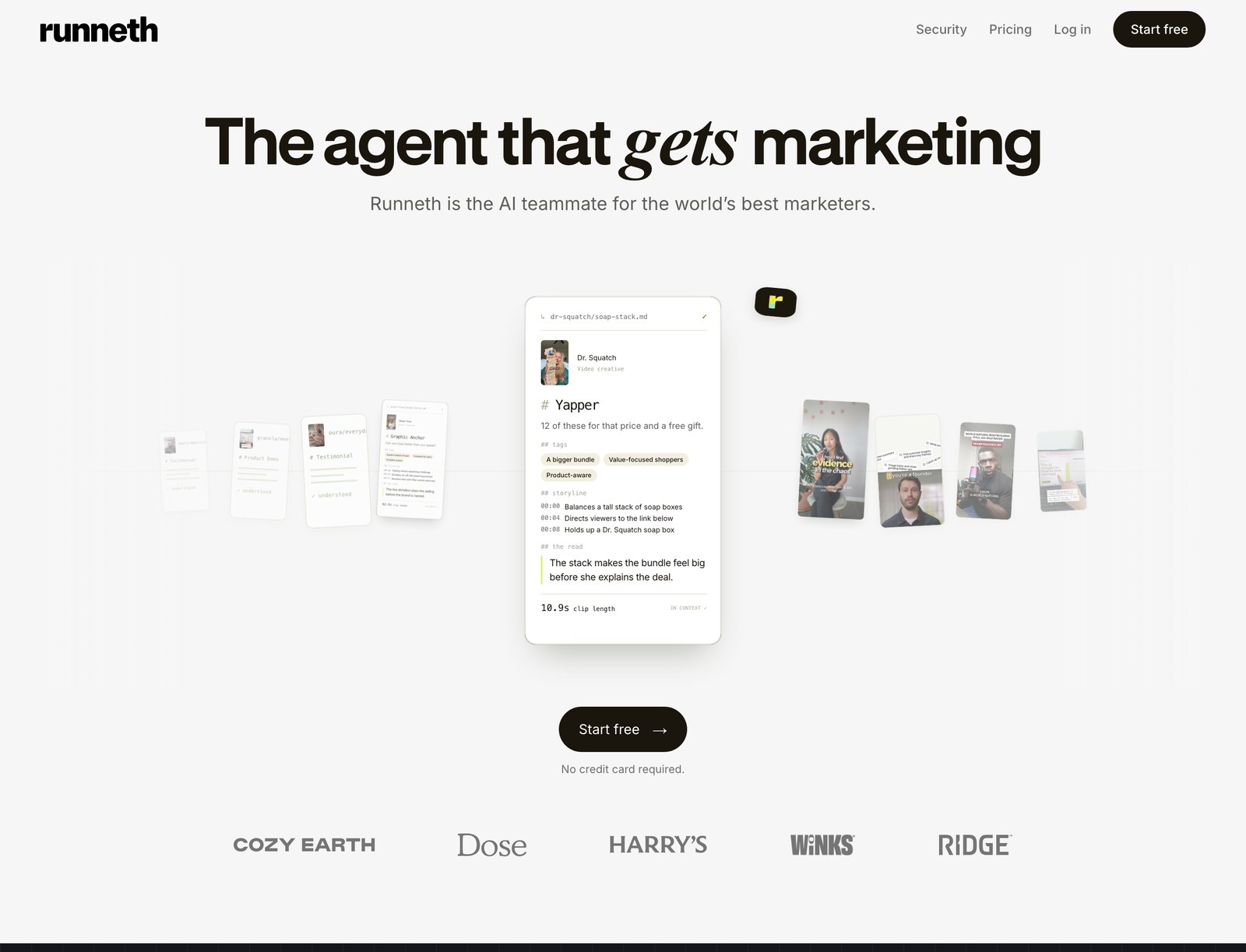
What it does, per Motion's docs: pre-watches, tags and analyzes every creative you've run; writes hooks across 35+ tactic types and turns concepts into production-ready briefs; researches competitors through ad libraries; audits landing pages; runs scheduled routines like weekly performance reads and competitor digests posted to Slack.³ It generates static ads, with their own honest caveat that video generation isn't there yet.¹ Ad-account data comes from Meta and TikTok, plus integrations with Klaviyo, HubSpot, Shopify, Northbeam, GA4, Google Drive and Notion.¹
What it doesn't do: buy media. There is no budget management, no bid optimization, no campaign management anywhere in Motion's materials. The one ad-launching demo on runneth.com is labeled illustrative, and "closed-loop pipelines from signal to launched ad" appear only on the Growth tier, built together with Motion's team.² That's not a dig; it's deliberate positioning. Runneth advises, your team pulls the trigger.
What Adside actually is
Adside is an AI all-in-one platform for running profitable ads, and the center of gravity sits exactly where Runneth stops: after the decision. Connect your Meta, Google and LinkedIn accounts and the agent generates static creatives, launches campaigns in bulk with your naming convention enforced at upload, watches performance 24/7, rotates fatigued ads automatically, and assembles client-ready reports. Competitor tracking is built in as market intelligence, though I'll say plainly that Motion's creative analysis goes deeper than ours: they've been tagging video frames since 2021 and it shows.
Pricing is one number: $990 per brand per month with everything included, $590 if you prepay annually. Teams that want a human running the account use the managed service from $3,500 a month. No spend tiers, no usage meter, no sales call to switch features on.
We also don't do TikTok. If TikTok is your main channel, neither half of this comparison should sway you toward Adside.
The side-by-side
| Runneth (Motion) | Adside | |
|---|---|---|
| Core job | Creative strategy and analysis | Campaign execution and management |
| Ad channels | Meta, TikTok (data and analysis)¹ | Meta, Google, LinkedIn (launch and manage) |
| Creates ads | Static ads; no video yet¹ | Static ads; video via integrations |
| Launches campaigns | Growth-tier pipelines, built with Motion's team² | Core feature, bulk, all plans |
| Monitors and optimizes | Reports and alerts; humans act | Auto-rotation, fatigue detection, alerts |
| Lives in | Slack, Motion app, CLI | Web app, Slack, MCP |
| Infrastructure | Dedicated VM per org, SOC 2 Type I⁶ | Multi-tenant SaaS |
| Entry price | $999/mo up to $50k spend² | $990/mo per brand, flat |
| Above entry | Quote-based Pro and Growth tiers | Same price |
| Usage | Metered; pauses at 100%⁴ | Included |
| Agencies | Separate Motion org per client⁴ | Multi-brand workspace |
| Best fit | DTC teams shipping heavy creative volume | Teams who want the ads run, including B2B |
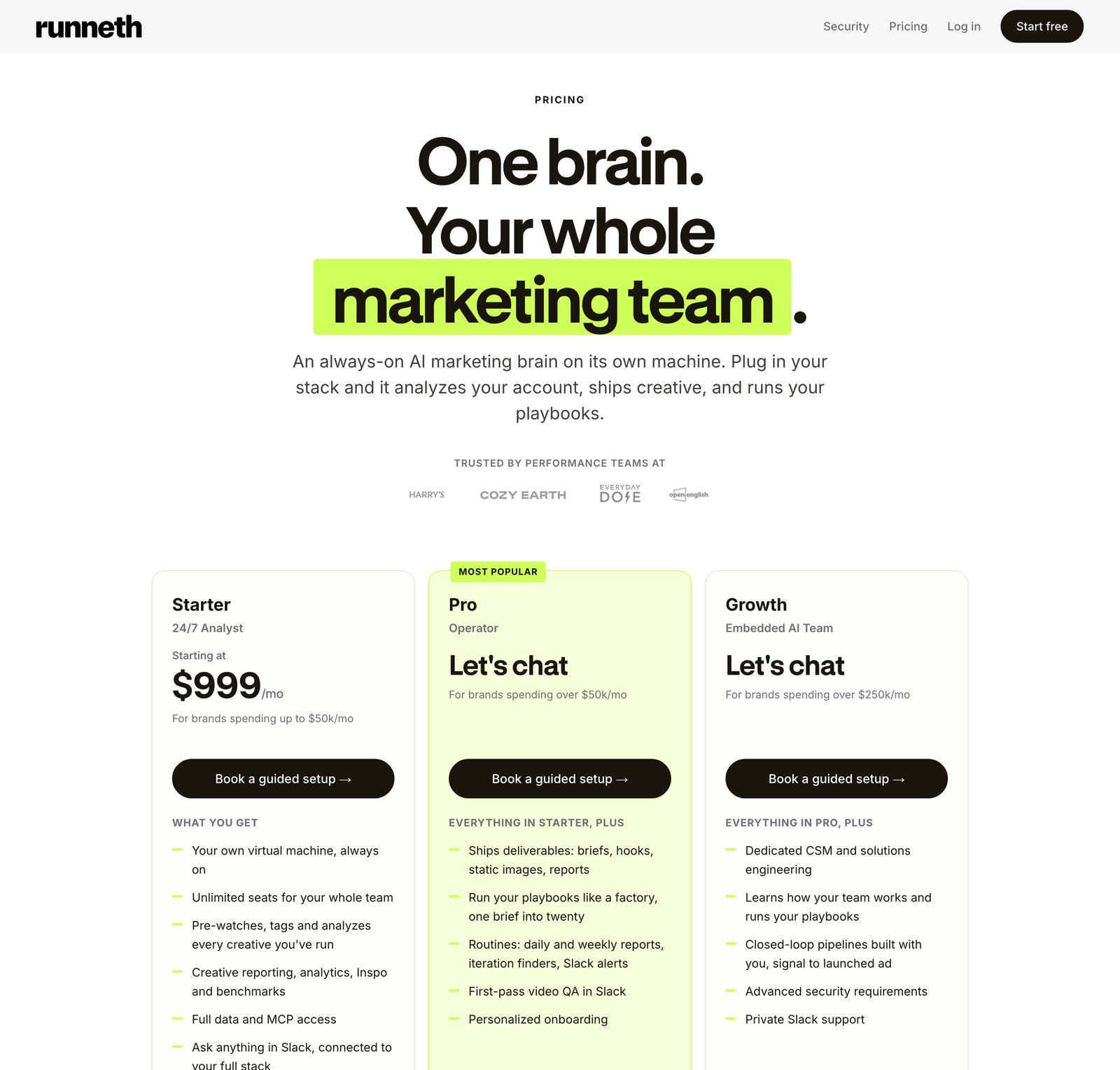
Two $1,000 products, different purchases
The entry prices are nine dollars apart, which makes the comparison unusually clean: what does the first thousand dollars buy?
On Runneth's Starter it buys analysis. The VM, unlimited seats, pre-watching and tagging of every creative, benchmarks, and Slack access to your stack.² Deliverables are where it gets murky: runneth.com puts briefs, static ads and routines in the quote-based Pro tier, while motionapp.com's pricing page puts routines and Slack-requested briefs in Starter. The two pages also disagree on where Growth starts ($250k versus $125k monthly spend).²⁸ I'd treat the real packaging as whatever your sales call says: activation goes through their team either way, since Runneth isn't in the free trial by default.⁴ Usage is metered too. Each plan includes a monthly allowance, and at 100% Runneth pauses until the next cycle.⁴
On Adside, $990 buys execution: generation, launch, monitoring, rotation and reporting as product features, self-serve, with the price staying put as spend grows. Spend-tiered pricing imports agency logic into software: your costs rise with your ad budget even when the work doesn't change. I understand why vendors like it. I've just never met a buyer who does.
A useful tell when comparing AI ad tools: ask whether the thing you're paying for ends in a document or in a live campaign. Documents still need someone to act on them.
Where Runneth is the better pick
Three honest cases. First: creative intelligence is genuinely their home turf. Five years of tagging hooks, angles and formats across billions in DTC spend produces benchmarks and pattern-finding we don't match. If your team argues about which hook to test next, Runneth settles those arguments with data.
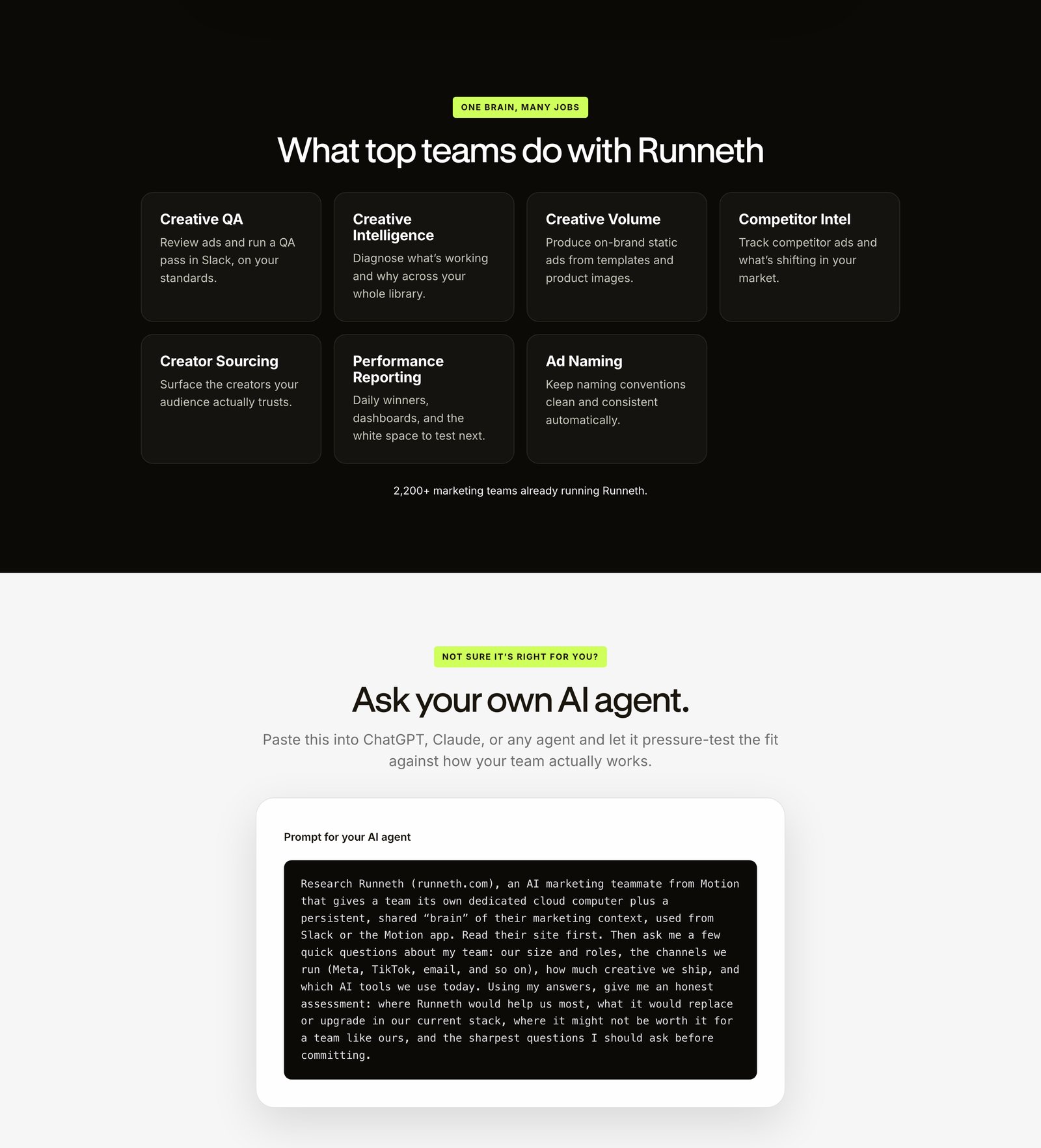
Second: high-volume creative operations on Meta and TikTok. A DTC brand shipping 50+ creatives a month has real QA, naming, briefing and creator-management load, and Runneth's use cases (creative QA, first-pass video QA in Slack, creator sourcing, ad naming) map to exactly that team.¹ The Slack-native workflow is well built; the one named G2 review praises precisely that.⁹
Third: the Brain is a real idea. An org-wide memory that both the agent and every teammate share, accumulated over months, is worth more than another chat window. If your marketing knowledge currently lives in one strategist's head, that alone can justify the subscription.
Where Adside is the better pick
First: you want the ads run, not described. The expensive hours in most ad teams aren't spent deciding what to make; they're spent uploading variants, checking frequency, pausing losers and rebuilding reports. That work is Adside's core product at $990, versus a Growth-tier pipeline co-built with Motion's services team for $250k+/mo spenders.²
Second: Google and LinkedIn. Runneth's documented ad-platform coverage is Meta and TikTok, which tracks Motion's DTC heritage.¹ If you're a B2B company, LinkedIn plus Google search is probably most of your paid program, and an analyst that can't see those channels is analyzing someone else's business.
Third: predictable multi-brand economics. Agencies on Runneth need a separate Motion organization per client, each priced against that client's spend.⁴ Adside's per-brand flat fee makes the margin math knowable before you sign the client. And since both products expose MCP access, your own agents can drive either; ours plugs into the same MCP workflows we've written about before.
How to choose
Listen for which sentence your team says more often. "We don't know what creative to make next" is a Runneth problem. "We know exactly what to make, and it still takes us all week to ship, monitor and report it" is an Adside problem.
My judgment call, stated as one: under $50k a month in spend, paying $999 for analysis alone is backwards. At that size your constraint is reps, shipping and iterating fast enough for the data to mean anything, not the sophistication of the analysis. Past $100k a month on Meta and TikTok with a dedicated creative team, the calculus flips and Runneth's depth starts paying for itself. And the honest edge case: a large DTC team could run both, Runneth deciding what to make, Adside keeping it live, tested and rotating on a real testing cadence.
Whichever way you lean, do what Runneth's own site suggests: paste both products into your AI agent of choice and ask it to pressure-test the fit against how your team actually works. We're comfortable with where that lands.
Frequently asked questions
Is Runneth the same thing as Motion?
Runneth is a product by Motion, the Toronto creative analytics company founded in 2021. It launched on June 24, 2026 and is included in every paid Motion plan rather than sold separately. Motion is clearly re-fronting its marketing under the Runneth brand (runneth.com now hosts the whole Motion blog), but the login, the data and the company behind it are still Motion.
Does Runneth launch and manage ad campaigns?
Not as a core product feature. Runneth analyzes creatives, writes briefs and hooks, generates static ads, and reports, but Motion's own materials describe no media buying, budget or bid management. An ad-launching demo on runneth.com is labeled illustrative, and closed-loop pipelines from signal to launched ad are a Growth-tier engagement built together with Motion's team, for brands spending $250k+ per month.
How much does Runneth cost?
The Starter plan is $999 per month for brands spending up to $50k per month on ads. Above that, Pro and Growth are quote-based. Usage is metered: each plan includes a monthly allowance of Runneth usage, and when you hit 100% it pauses until the next cycle. Activation goes through Motion's sales team; it is not part of the free trial by default.
Does Runneth work with Google Ads or LinkedIn Ads?
Runneth's documented ad-platform connections are Meta and TikTok, which matches Motion's DTC and ecommerce heritage. Its integration list covers Slack, Klaviyo, HubSpot, Google Drive, Notion, Shopify, Northbeam and GA4, but neither Google Ads nor LinkedIn Ads appears as a managed ad channel. Teams that live on Google or LinkedIn, which is most B2B, are outside its current scope.
Can you use Adside and Runneth together?
Yes, because they occupy different stages of the same workflow. Runneth is strongest before the launch: creative analysis, competitor research, briefs. Adside is strongest from the launch onward: generating statics, uploading across Meta, Google and LinkedIn, monitoring and rotating ads. A DTC team spending $100k+ per month could reasonably run both; a smaller team should pick the stage that is actually their bottleneck.
Sources
- Runneth capabilities, integrations, static-ads caveat and FAQ — What is Runneth, runneth.com (2026)
- Plans, $999 Starter, spend thresholds and tier features — Runneth pricing (2026)
- Launch date, creative analysis and strategy features — Getting started with Runneth, Motion help center (2026)
- Plan inclusion, usage metering, sales activation, per-client orgs — Runneth, included in your Motion plan, Motion help center (2026)
- Motion funding, founders and customer counts — Motion closes $30M Series B, BetaKit (2024); current counts from motionapp.com (2026)
- Dedicated VM, Azure hosting, SOC 2 status, data retention — Runneth security (2026)
- Launch framing and 2,200+ customers claim — Reza Khadjavi, launch essay (2026)
- Alternate tier features and $125k Growth threshold — Motion pricing (2026)
- Practitioner feedback on Motion and Runneth — Motion reviews, G2 (2026)